
USA Trusses
🏗️ USA Trusses Introduction to Truss Design
As USA Trusses go, a truss is a structure consisting of members organized into connected triangles. This triangular shape is key because it is mathematically stable—it cannot be deformed without changing the length of one of its sides.
Core Terminology
- Chords: The outer members. The Top Chord usually handles compression, while the Bottom Chord handles tension.
- Webs: The interior members that connect the top and bottom chords.
- Nodes (Joints): The points where members intersect. In a perfect truss model, we assume these are “pinned” (free to rotate).
- Span: The horizontal distance the truss covers.
📐 Common Truss Types
Before designing, you must choose the right “topology” for your project:
| Type | Best Use Case | Visual Characteristic |
| King Post | Short spans (garages, sheds) | A simple center vertical post. |
| Fink Truss | Standard residential roofs | Webbing creates a “W” shape. |
| Howe Truss | Heavy loads/Bridges | Vertical members are in compression. |
| Pratt Truss | Long spans | Vertical members are in tension. |
🔢 The 5-Step Design Process
1. Define the Load
You must calculate the total force the truss will encounter. This includes:

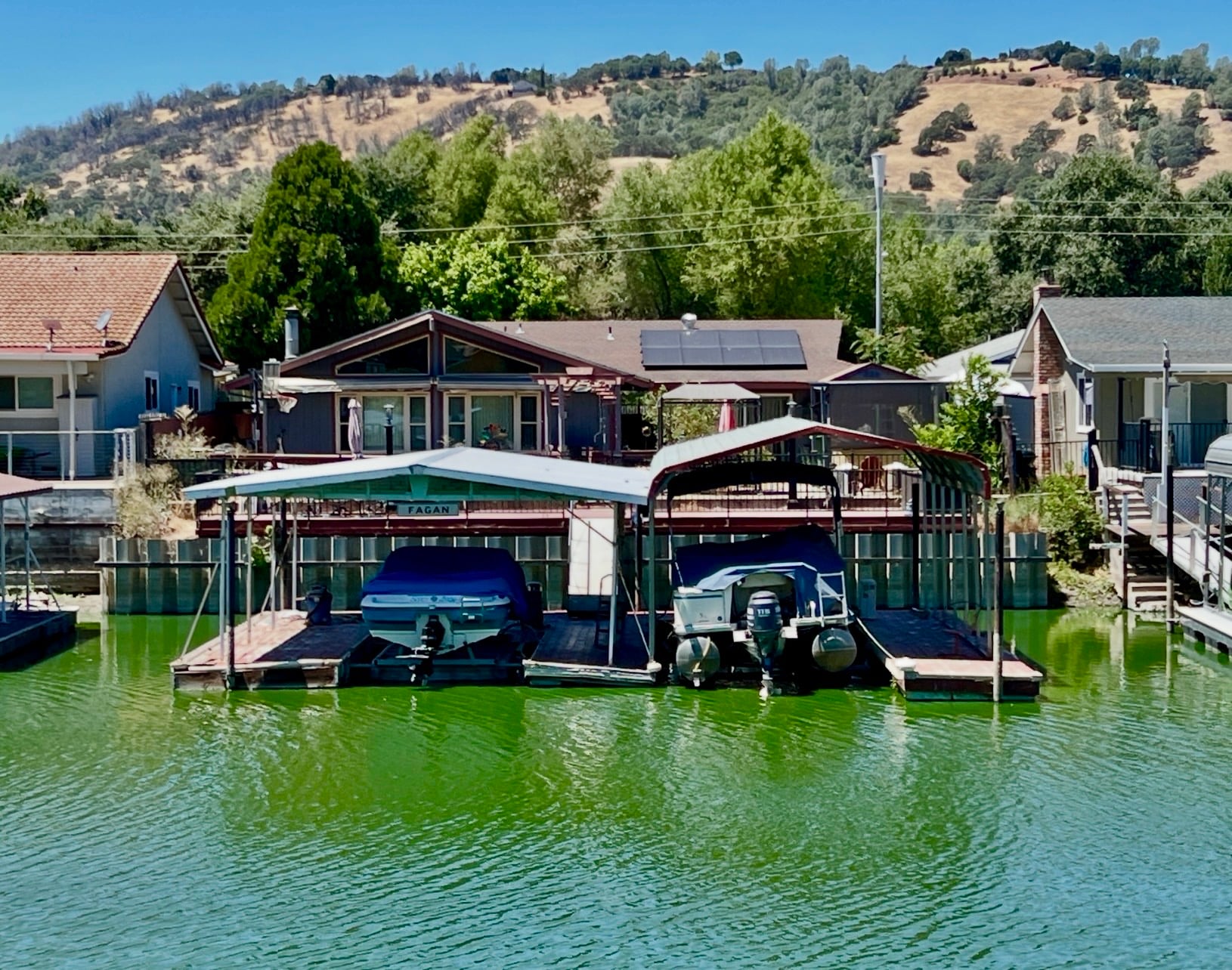
Northern California Luxury Home
- Dead Load: The weight of the truss itself and the roofing materials.
- Live Load: Temporary weights like workers or equipment.
- Environmental Loads: Snow, wind, and seismic activity.
2. Determine Geometry
Decide on the Pitch (the slope) and the Span. A steeper pitch generally handles snow better but requires more material.
3. Analyze the Forces
To find the internal forces in each member, engineers typically use the Method of Joints. This involves ensuring that the sum of all forces at every node equals zero:
$$\sum F_x = 0$$
$$\sum F_y = 0$$
4. Select Materials
Once you know the force (Tension or Compression) in each member:
- Tension members can be thinner (like steel cables or rods).
- Compression members must be thicker or braced to prevent buckling.
5. Connection Design
The joints are often the weakest link. In modern residential construction, metal connector plates (gusset plates) are pressed into the wood to join the members securely.
🛠️ Pro-Tips for Stability
- Triangulation is King: If you see a square in your design, it will collapse. Add a diagonal member to turn it into two triangles.
- Symmetry: Whenever possible, keep your truss symmetrical to simplify load distribution and manufacturing.
- Software: While hand calculations are great for learning, tools like RISA-3D or specialized wood truss software are used for professional-grade safety.

The Evolution of Prefabricated Framing in Modern Construction
When evaluating the history of engineered roof systems, it is clear that the transition from site-built rafters to factory-made components revolutionized the housing industry. Modern architectural planning leverages sophisticated CAD software to calculate exact load-bearing capacities, allowing for expansive open-floor plans that were once impossible with traditional stick framing. By utilizing these advanced systems, builders can significantly reduce material waste and on-site labor costs, as each section is prefabricated to millimeter-level precision in a controlled environment.
Precision Installation and Bracing Protocols
The efficiency of a structural framework is only as good as its field execution. Once the engineered units arrive at the job site, mechanical cranes are typically employed to hoist each segment into its vertical orientation. Temporary lateral restraints are essential during this phase to prevent “domino-style” collapses before the permanent roof sheathing is applied. Builders must ensure that every segment is perfectly plumb and aligned with the exterior load-bearing walls. This stage of assembly requires a rigorous adherence to the provided layout maps, ensuring that the spacing between units—often 24 inches on center—is maintained to distribute weight evenly across the entire building envelope.
Longevity and Environmental Protection
Maintaining the health of a skeletal roof system requires a proactive approach to moisture management and ventilation. Attic spaces must be properly vented using a combination of soffit and ridge vents to prevent the buildup of stagnant, humid air. If condensation is allowed to accumulate on the lumber members, it can lead to fungal growth or “plate pull-out,” where the metal connectors begin to lose their grip on the wood fibers. Regular inspections should focus on signs of sagging or localized stress fractures, particularly after record-breaking weather events. By keeping the timber dry and the air flowing, the skeletal integrity of the home remains uncompromised for the life of the mortgage.
The Physics of Triangular Stability
At its core, the success of this building method relies on the geometric rigidity of the three-sided shape. Unlike a rectangular frame, which can skew into a parallelogram under lateral pressure, a triangle cannot change its interior angles unless the length of one of its sides is physically altered. This principle allows for the creation of massive vaulted ceilings and open-concept “great rooms” that would otherwise require heavy, expensive steel beams or intrusive mid-span columns. By harnessing the natural tensile and compressive strengths of high-grade wood, architects can push the boundaries of modern residential aesthetics while maintaining a strict margin of safety.
Advanced Engineering and Stress Analysis
The true strength of a sophisticated structural layout lies in its ability to distribute hydraulic and environmental pressures across a network of interconnected triangles. Engineers prioritize the “Stiffness Matrix” method to predict how a frame will react under extreme stress, such as heavy snow loads or high-wind events. This level of mathematical rigor ensures that every component produced for residential or commercial use exceeds local building codes, providing a structural backbone that lasts for generations.
Material Selection for High-Performance Frames
Selecting the right grade of lumber or steel is a critical phase of the planning process. For most high-performance frames, high-density Southern Pine or Douglas Fir is used because of its excellent strength-to-weight ratio. During the calculation phase, each piece of wood is assigned a specific stress grade, ensuring that the upper members can withstand massive compression while the lower segments remain stable under high tension. This careful synergy between material science and geometric layout is what defines a high-quality structural component.
Long-Term Benefits of Quality Structural Planning
Ultimately, investing in professional structural engineering offers more than just stability; it provides architectural flexibility. Because these skeletal systems can span great distances without the need for interior load-bearing walls, homeowners have the freedom to redesign their interior spaces decades after the initial build. As the industry moves toward more sustainable building practices, the efficiency of a well-executed structural layout remains the gold standard for eco-friendly, durable, and cost-effective American construction.
Common Questions Regarding Engineered Roof Supports
How do these triangular frameworks provide more interior space than traditional rafters? Because these systems are designed to transfer all weight to the exterior load-bearing walls, they eliminate the need for interior support columns or walls. This engineering allows for “clear-span” interiors, giving homeowners the ability to create wide-open floor plans or vaulted “great rooms” that would be structurally impossible with standard stick-framing methods.
What is the standard spacing for these prefabricated segments? In most residential applications, these units are installed at 24 inches on center. This specific interval is the industry standard because it optimizes material efficiency while providing more than enough strength to support standard plywood sheathing, heavy roofing tiles, and significant environmental loads like accumulated snow or high winds.
How can a homeowner identify if their attic support system is under stress? Visual cues are usually the first indicator of structural fatigue. Look for “plate pull-out,” where the metal teeth of the connector plates begin to back out of the wood. Other red flags include localized sagging in the roofline, cracks in the drywall of the ceiling below, or doors that suddenly begin to stick in their frames, which can signal that the overhead weight is not being distributed correctly.
Partner Spotlight: American Truss Company
If you are looking for high-quality, engineered wood components, we recommend connecting with the experts at American Truss Company. They specialize in taking your architectural visions from a simple PDF blueprint to a fully realized structural framework.
Core Services
- Custom Design & Bidding: They provide expert-level bidding and design services at no initial cost, ensuring your plans are structurally sound before production begins.
- Precision Manufacturing: Their facility produces a wide variety of specialized shapes, including:
- Attic & Bonus Room Frames for maximized headspace.
- Scissor & Vaulted Designs for dramatic interior ceilings.
- Hip, Gable, and Mono-pitched configurations for any architectural style.
- Floor & Wall Systems: Beyond the roof, they offer engineered floor joists and framing solutions to provide a complete structural envelope.
Primary Service Locations
Located in the rolling hills of rural Two Rock Valley, they primarily serve the Petaluma, CA area and the broader Northern California construction market.
Contact Information:
- American Truss Company
- Location: 4550 Spring Hill Road, Petaluma, CA 94952
- Phone: (707) 763-8713
- Website: amtrussco.com
Connect with a Real Estate Expert
Buying, selling, or investing? Submit your info and we’ll connect you with the right licensed professional for your situation — fast, free, and with no pressure.
A specialist will reach out within 1 business day.