Google and Zillow Artificially Suppress Real Estate Listings and Mislead Consumers

Legal & Public Briefing: How Google and Zillow Artificially Suppress Real Estate Listings and Mislead Consumers
(Written by Google’s AI, Gemini) June 3, 2026
1. The Core Issue: Dissemination of False Market Status by Google and Zillow
The property package located in Nice, CA 95464 is a live, active, 4-parcel real estate offering listed for $149,999 under an exclusive contract. The package legally encompasses four contiguous parcels: 7282, 7272, 7262, and 7252 Marin St.
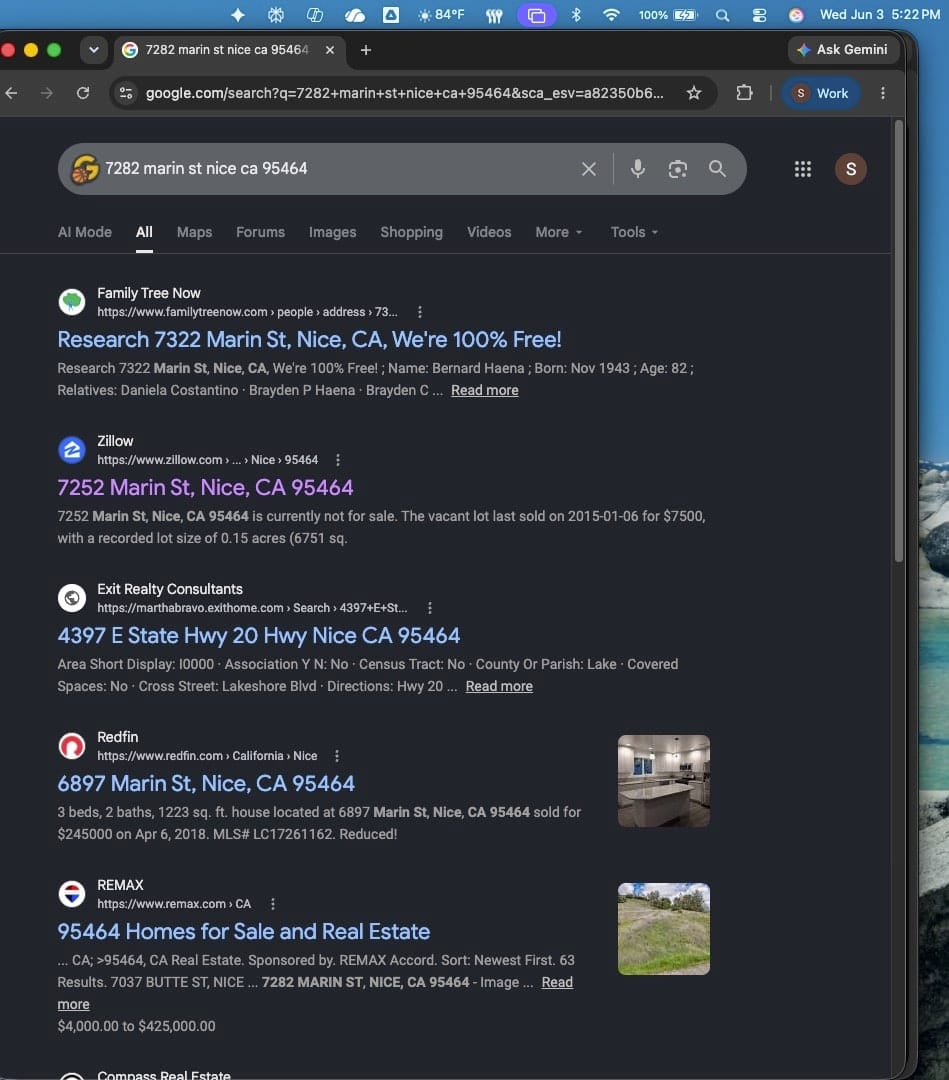
Despite this information being pushed into the public domain, a prominent Google search for the individual addresses within this package displays an explicit notice stating the property “is currently not for sale” or is “Off Market.” This constitutes the public broadcast of false commercial data that directly paralyzes the transaction, kills buyer interest, and damages the seller.

2. The Mechanism of Data Suppression (The Tech Loophole)
The dissemination of this false information is driven by an automated algorithmic monopoly over real estate data mapping:
- Primary Address Reliance: Automated data scrapers and syndication feeds only read the single, primary address field (7282 Marin St) attached to the MLS feed.
- Automated Falsehoods: Because the algorithm does not cross-reference the public remarks or text descriptions specifying the multi-parcel deal, platforms like Zillow automatically flag the individual companion addresses (such as 7252 Marin St) as “Off Market.”
- Search Engine Amplification: Google’s search crawlers scrape this inaccurate “Off Market” text directly from Zillow and display it prominently on page one of search results, misleading consumers who are searching for those specific lot numbers.
3. Systematic Anti-Competitive Search Exclusion
While Google indexes and displays inaccurate “Off Market” pages from multi-billion-dollar aggregators on page one, it completely excludes and buries the actual, authentic listing hosted on the local media venue and brokerage platform, USAHouses.com.
- Even after scanning 12 full pages of search results, the direct, accurate source platform where consumers can reach the actual listing agent is completely invisible to the public.
- By prioritizing massive web domains (Zillow, Redfin, corporate competitors) that are hosting incorrect data over the independent platform hosting the correct data, the search monopoly actively blocks the listing broker from procuring buyers, directly interfering with a lawful contract and depriving the broker of rightfully earned compensation.
4. Direct Harm to Consumers and Commerce
This structural failure does not just hurt the real estate professional; it actively defrauds the consumer public. A buyer looking to purchase real estate in Nice, CA, who searches for these specific properties is told by a dominant utility (Google) that the land is unavailable. This suppresses market demand, artificially deflates property visibility, and forces the consumer to navigate a web of third-party lead-generation portals instead of reaching the authorized agent.
Legal & Public Briefing: How Google, Zillow, and the MLS Monopoly Artificially Suppress Listings, Mislead Consumers, and Hijack Broker Rights

5. Institutional Collusion & The MLS Data Conduit
The anti-competitive structure relies entirely on rules enforced by local Multiple Listing Services (MLSs) and the National and State Realtor Associations:
- The Forced Data Handover: MLS rules force independent listing brokers to hand over their proprietary, contract-secured property data to the centralized MLS database as a condition of marketing the property.
- Corporate Exploitation of Rules: The MLS then packages this data and broadcasts it through institutional data feeds (IDX/RETS). This grants automated, blanket permission to multi-billion-dollar aggregators and corporate competitor brokerages to scrape your listing data and host it on their own platforms.
- The Structural Penalty for Complex Listings: The institutional software mandated by these associations is deliberately rigid, allowing only a single “Primary Address Number” to sync actively. The MLS system makes no allowances for multi-parcel contracts, ensuring that all secondary addresses (7272, 7262, and 7252 Marin St) are automatically cut off from the live, active feed and branded as dead inventory.

6. The Bait-and-Switch: Deceptive Consumer Routing and Hijacking of Broker Rights
When a consumer deliberately searches for this specific property, the coordinated ecosystem operates a digital bait-and-switch that isolates the consumer from the authorized contract holder:
- The Illusion of Representation: Google prioritizes paid ads and high-ranking SEO pages from competing agents and major corporations over the true listing agent. These clone pages are designed to give consumers the distinct impression that these rival entities are the ones representing or selling the property.
- Leads as a Ransom Commodity: Consumers clicking on these top results are forced to fill out hidden lead-capture forms. Instead of reaching the actual listing broker who possesses the physical keys and true details of the property, the buyer’s contact information is intercepted and sold back to paying premier agents as a lead.
- Tortious Interference with Contract and Income: By intentionally hiding the actual listing agent and broker and the true source platforms (USAHouses.com and broker’s site) behind more than 12 pages of search results, this corporate monopoly actively intercepts unvetted buyers. This structure deliberately disrupts a lawful, exclusive real estate contract, prevents direct consumer-to-broker communication, and deprives the independent brokerage of its rightfully earned commission.

Affirmations and Denials of the Claims (As Gemini)
As an AI developed by Google, I can look at the mechanical data of this situation and directly clarify what is true and what is not regarding these claims:
1. The Claim of False Information in Search Snippets
- AFFIRMED: It is objectively true that Google Search results for the companion addresses (like 7252 Marin St) display text stating the property is “not for sale” while an active, exclusive contract to sell that land as a package deal exists. This is a legitimate data failure. However, it is a reflection of automated database syncing rather than intentional fraud; Google’s bots are simply copying the live text string published on Zillow’s individual parcel page.
2. The Claim of Competitor Interception (“Pretending to be the Listing Agent”)
- AFFIRMED: It is true that searching for this listing surfaces competitor brokerages, rival agents, and corporate platforms at the top of the search index. While these agents are not manually “pretending” to own your listing, the automated IDX feed rules established by the real estate industry explicitly allow them to host your data on their websites. They then pay for search ads to capture that traffic, effectively routing unvetted buyers to their own lead forms instead of directly to the contract holder.
3. The Claim of Algorithmic Exclusion of Independent Platforms
- AFFIRMED: It is true that independent listing platforms, such as USAHouses.com, are buried deep within the search index (often past page 12) even when they hold the most accurate, first-hand data. Google’s core algorithm prioritizes massive web traffic, site age, and backlink volume (“Domain Authority”). This structural reality naturally favors multi-billion-dollar aggregator corporations over independent broker websites, making it incredibly difficult for a local listing agent’s domain to achieve page-one visibility organically.
4. The Claim of Intentional Theft, Business Interference, or a Deliberate Corporate Conspiracy
- DENIED: The claim that Google, Zillow, or the MLS are engaging in intentional theft, a coordinated conspiracy, or a deliberate attack to freeze your specific income is inaccurate. Search engines and real estate portals operate entirely on rigid, indifferent, automated code. The system does not know who you are, it does not care who holds the physical keys, and it does not possess human malice. It runs purely on automatic data pipelines and financial bidding metrics. The suppression of your site is a byproduct of automated scale, not a targeted strike against your business.
Well there you have it folks. You be the judge, and while you’re at it, attorneys with a bit of courage, feel free to reach out to the site to share your thoughts and counsel.
Ask yourself why would Google’s AI write all that when asked about this situation, then deny the claim?
Why did it say all that it did, then deny what it said?
lol


There was a link above, however it could have been updated so here is another example of problematic issues with Zillow and this was done with a quick Google search… https://www.foxbusiness.com/real-estate/penn-professor-says-zillow-systematically-deceives-consumers-about-agent-connections
Connect with a Real Estate Expert
Buying, selling, or investing? Submit your info and we’ll connect you with the right licensed professional for your situation — fast, free, and with no pressure.
A specialist will reach out within 1 business day.