New-home range
$300k–$625k+
Orientation for major Arizona metros already covered on USAHouses.com — Phoenix, Tucson, Mesa, Chandler corridors vary.
Arizona · Houses & Real Estate
Explore Arizona houses, regional markets, new construction, and local expertise — start with city guides, counties, and verified statewide orientation.
Arizona Market Snapshot
Clean ranges for orientation — useful for Arizona houses and real estate planning, not a brochure substitute for local advice.
Figures can vary by source and timing. Arizona market pace also varies by region — including high-demand metros and fast-growing secondary markets.
Arizona City Guides
Natural-path city pages for Arizona houses, homes, and local market context — start here, then drill into counties and new construction. These city guides keep major Arizona market links (Phoenix, Tucson, Mesa, Chandler, Scottsdale, Gilbert, Glendale, Tempe, and more) in one place.
All 116 Arizona city guides on USAHouses.com — natural paths only.
Arizona Counties
All 15 Arizona counties — linked to existing USAHouses.com county pages when present.
All 15 Arizona counties on USAHouses.com.
New Construction
Browse active new-construction communities across Arizona — map and search open after a quick name + email access form. No large NewUSAHouses chrome iframe on load.
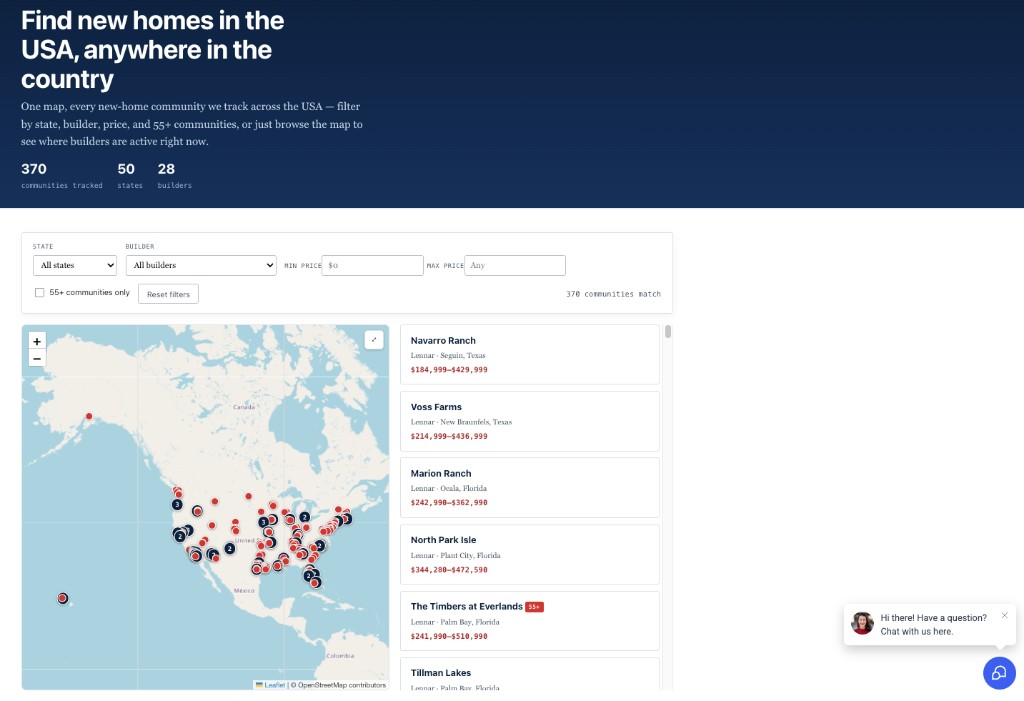
Live Arizona community map opens after quick access
At a glance
Arizona is multiple regional markets; values vary widely by metro. Arizona has a state income tax — confirm brackets, property tax, insurance, and HOA locally.
7,268,175
$76,872
$358,900
$467,000
$1,431/mo
−1.6%
Yes — confirm locally
Statewide figures are orientation only — confirm current local numbers before you act.
Arizona Specialists
Tell us whether you want to buy, sell, pursue new construction, or invest — then share a city or metro when you can.
Local expert form loads when you are ready.
Arizona Deep Dive
Long-form Arizona houses & real estate guidance — then city links and FAQs.
Arizona houses and real estate sit at the intersection of Sun Belt migration, a large Phoenix metro economy, and distinctly different Tucson, Flagstaff, and border-corridor markets. Buyers researching Arizona homes for sale should treat the state as a set of regional housing systems — not one statewide price or pace.
Use the market snapshot and glance figures above for statewide orientation, then move into city guides, counties, and the sections below for process, ownership costs, and regional context. Listings and closed sales still vary widely by city, product type, and HOA rules — confirm locally.
USAHouses.com organizes Arizona research through city guides, county context, new-construction pathways, and local-expert connections.
| Population | 7,268,175 |
|---|---|
| Median household income | $76,872 |
| Median home value | $358,900 |
| Median gross rent | $1,431/mo |
| Median listing price | $467,000 |
| Recent price trend (approx.) | −1.6% |
| Counties | 15 |
| State income tax | Yes — flat individual rate; confirm current ADOR materials |
| Nickname | Grand Canyon State |
Statewide figures are orientation only — confirm current local numbers before you act.
Arizona’s housing conversation is dominated by the Phoenix–Mesa–Scottsdale area, where employment, new master-planned communities, and resale inventory set the tone for most national coverage. Tucson operates as a separate major market with university, healthcare, and defense anchors. Northern Arizona (Flagstaff and mountain communities) and western corridor cities such as Yuma behave differently on seasonality, insurance, and second-home demand.
Statewide medians are useful for orientation, not for pricing a Scottsdale condo or a West Valley production home. Active listings often skew newer or larger than the full owner-occupied stock, so asking prices and long-run value estimates can diverge.
Inventory, days on market, builder incentives, and HOA fees change the monthly payment as much as purchase price. Pair the snapshot above with a city guide and current local comps before you lock a budget.
Arizona spans low desert, high desert, and mountain climate bands. Phoenix-area summers are long and hot; monsoon storms matter for drainage, roof condition, and insurance claims history. Tucson shares desert heat with different topography. Flagstaff and other elevation communities bring snow, freeze-thaw cycles, and different HVAC expectations.
Wildfire risk, water rules, and flood-zone designations are property-specific. Review seller disclosures, insurance quotes, and local water-provider notes early — especially for hillside, wildland-urban interface, or irrigation-dependent parcels. Confirm locally with licensed professionals and municipal sources.
Dust, sun exposure, and monsoon microbursts influence exterior paint, roof coatings, and window performance. Elevation changes between the Valley and northern Arizona rewrite heating needs and driveway maintenance.
Start with live USAHouses.com city guides when you need neighborhood-level pathways: Phoenix, Tucson, Mesa, Chandler, Scottsdale, Gilbert, Glendale, Tempe, Peoria, Surprise, Flagstaff, Yuma.
Phoenix, Tucson, Mesa, Chandler, Scottsdale, Gilbert, Glendale, Tempe, Peoria, Surprise, Flagstaff, Yuma
Phoenix anchors the state’s largest job base; Mesa, Chandler, Gilbert, Glendale, Peoria, Surprise, and Tempe form a wide Valley ring with different new-home and resale mixes. Scottsdale often leads luxury and resort-adjacent conversations. Tucson is the second major metro. Flagstaff serves northern Arizona; Yuma anchors the southwest corridor.
Arizona has 15 counties on USAHouses.com — use county pages when comparing neighboring jurisdictions, school districts, or unincorporated pockets, then verify zoning and services with the county or city.
Arizona housing stock includes production single-family homes in master-planned communities, older central-city ranch and mid-century product, townhomes and condos (including lock-and-leave inventory), manufactured and modular homes in some corridors, and custom desert or mountain homes on larger lots.
HOA frequency is high in many newer Phoenix-area and Tucson-area subdivisions. Budget for dues, transfer fees, and rental or parking rules. Age-restricted and active-adult communities are a meaningful segment in several metros — confirm age rules and resale restrictions before you write an offer.
New construction is a large share of move-in inventory in growth rings; resale can offer established landscaping and different lot orientation. Compare warranties, energy features, and lot premiums carefully.
A typical Arizona purchase runs through offer, negotiation, inspections, appraisal, loan conditions (if financed), title work, and closing. Exact timelines depend on contract forms, lender speed, HOA document delivery, and whether the home is new construction or resale.
Budget for a home inspection and, where relevant, pool, roof, sewer, and pest inspections. Desert properties may need extra attention to irrigation systems, stucco, HVAC capacity, and prior roof repairs. Insurance quotes should be requested early.
Get a lender pre-approval that matches the property type you will bid on. Solar leases and alarm contracts sometimes transfer awkwardly — request payoff terms in writing during contingencies. USAHouses.com is a platform/media marketplace, not a brokerage.
Arizona residential transactions commonly use standardized purchase-contract forms and seller property disclosures. HOA and condo associations often deliver resale packages with budgets, rules, and litigation notes — review them on the contract timeline.
Title and escrow companies play a central role in many Arizona closings. Closing customs, earnest-money handling, and wire-fraud precautions should be confirmed with your escrow officer and licensed professional. Do not rely on informal email wire instructions.
Local addenda for solar leases, irrigation shares, or short-term rental rules appear in some submarkets. Confirm what transfers with the property and what requires lender or association approval.
Closing costs typically include title/escrow fees, lender fees (if any), prepaid taxes and insurance, recording fees, and any HOA transfer costs. Who pays which fee is negotiable and market-dependent — confirm on your settlement statement.
New-construction contracts may shift costs differently than resale. Treat builder incentives as part of total economics, not free money — they can trade off against price, upgrades, or closing timing.
Ask for an estimated closing disclosure early and update it as HOA, insurance, and tax prorations firm up.
Sellers should prepare disclosure packages, gather HOA documents early, and price against recent nearby comps — not statewide medians. Peak showing seasons and summer heat can affect buyer traffic patterns differently by metro.
Pre-listing inspections, roof documentation, and HVAC service records can reduce renegotiation risk. In HOA communities, order the resale package early so buyers are not delayed.
Confirm capital-gains, withholding, and primary-residence questions with a tax professional — this guide does not provide tax advice.
Arizona remains one of the country’s more active production-home landscapes, especially across Phoenix-area growth corridors and selected Tucson edges. Master-planned communities may bundle parks, trails, and commercial pads with HOA governance.
Compare lot premiums, structural options, energy packages, and estimated completion dates. Visit both the model home and the actual lot. Confirm which amenities are open versus promised.
USAHouses.com offers a new homes map pathway to NewUSAHouses.com community search for Arizona — use the New Homes section above. Confirm any community claim on the builder’s official materials and with a local professional.
Relocation demand often traces to technology and semiconductor supply-chain investment, healthcare, universities, logistics, tourism/hospitality, defense and aerospace, and remote workers seeking Sun Belt climate. Exact employer footprints change — verify with metro economic-development sources when job access is your constraint.
Some buyers relocate for winter part-time living; others buy full-time and keep ties to California, the Midwest, or Canada. Seasonal demand can affect short-term rental rules in resort-adjacent areas — confirm locally.
Arizona lifestyle marketing emphasizes outdoor access, spring training and sports, and a large culinary scene in Phoenix and Tucson. Heat management is a practical daily factor — shade, pool operations, and utility bills belong in the ownership worksheet.
School options, commute patterns, and HOA lifestyle rules vary block by block. Use city guides as a shortlist tool, then visit at the time of day you would actually commute.
Ownership cost is more than principal and interest. Property tax, insurance, HOA dues, utilities (especially summer cooling), and maintenance drive the monthly picture.
Statewide orientation summaries often place Arizona toward the lower end of effective owner-occupied property-tax rates nationally. Local millage, assessment practices, and exemptions still dominate your bill — confirm with the county assessor and treasurer for the specific parcel.
Arizona homeowners may qualify for property-tax relief programs depending on occupancy and eligibility rules. Program names and amounts change — confirm current primary-residence relief with county and Arizona Department of Revenue resources.
Arizona levies a state individual income tax. The Arizona Department of Revenue describes a flat-rate structure for recent tax years. Confirm the rate that applies to your filing year on azdor.gov — do not treat this page as a tax calculator.
Homeowners insurance pricing reflects roof age, claims history, wildfire and wind exposure, and carrier appetite. Get quotes before removing financing contingencies. Flood insurance is separate when a flood zone applies.
Foreign buyers can purchase Arizona real estate, but financing, FIRPTA withholding on resale, identity documentation, and wire protocols require professional guidance. Title companies and lenders set their own documentation lists.
Currency transfer timing and U.S. bank setup should be planned before earnest money is due. This guide is orientation only — confirm with cross-border tax and real-estate counsel.
Three practical takeaways: (1) Phoenix-area and Tucson-area economics are not interchangeable; (2) statewide snapshot figures are orientation, not an offer strategy; (3) insurance, HOA, and heat-related utilities can move the monthly payment as much as a rate change.
A practical research sequence: pick Phoenix-area vs Tucson vs northern Arizona, shortlist two or three USAHouses.com city guides, run insurance quotes on representative properties, then debate finishes and upgrades.
Use the snapshot and glance figures at the top of this page for statewide orientation. Local metros and product types differ — confirm with current comps.
Yes. Arizona has a state individual income tax administered by the Arizona Department of Revenue. Confirm current rates for your tax year on official ADOR materials.
Many newer Phoenix-area and Tucson-area subdivisions use HOAs, but not every neighborhood does. Read CC&Rs and resale disclosures for the specific property.
New construction can offer warranties and modern energy features; resale can offer location maturity and different lot characteristics. Compare total monthly costs, not list price alone.
Use the statewide snapshot and city list on this page, then open two or three city guides (for example Phoenix, Tucson, Mesa) and compare commute and housing stock with a licensed local professional.
Official starting points (external sites; confirm current pages):
Compare neighboring USAHouses.com state guides when your search area crosses borders:
Major Arizona city guides for houses and local market context include Phoenix, Tucson, Mesa, Chandler, Scottsdale, Gilbert, Glendale, Tempe. Open a city or county page above when you are ready to go local.
Next steps
Use city guides above for local Arizona houses context, the capture-first new-homes map for construction communities, or the USAHouses.com marketplace when you are ready to browse broader listing pathways.